Dry Aged Beef: How Time and Science Transform Meat Quality
What Dry Aging Does to Beef
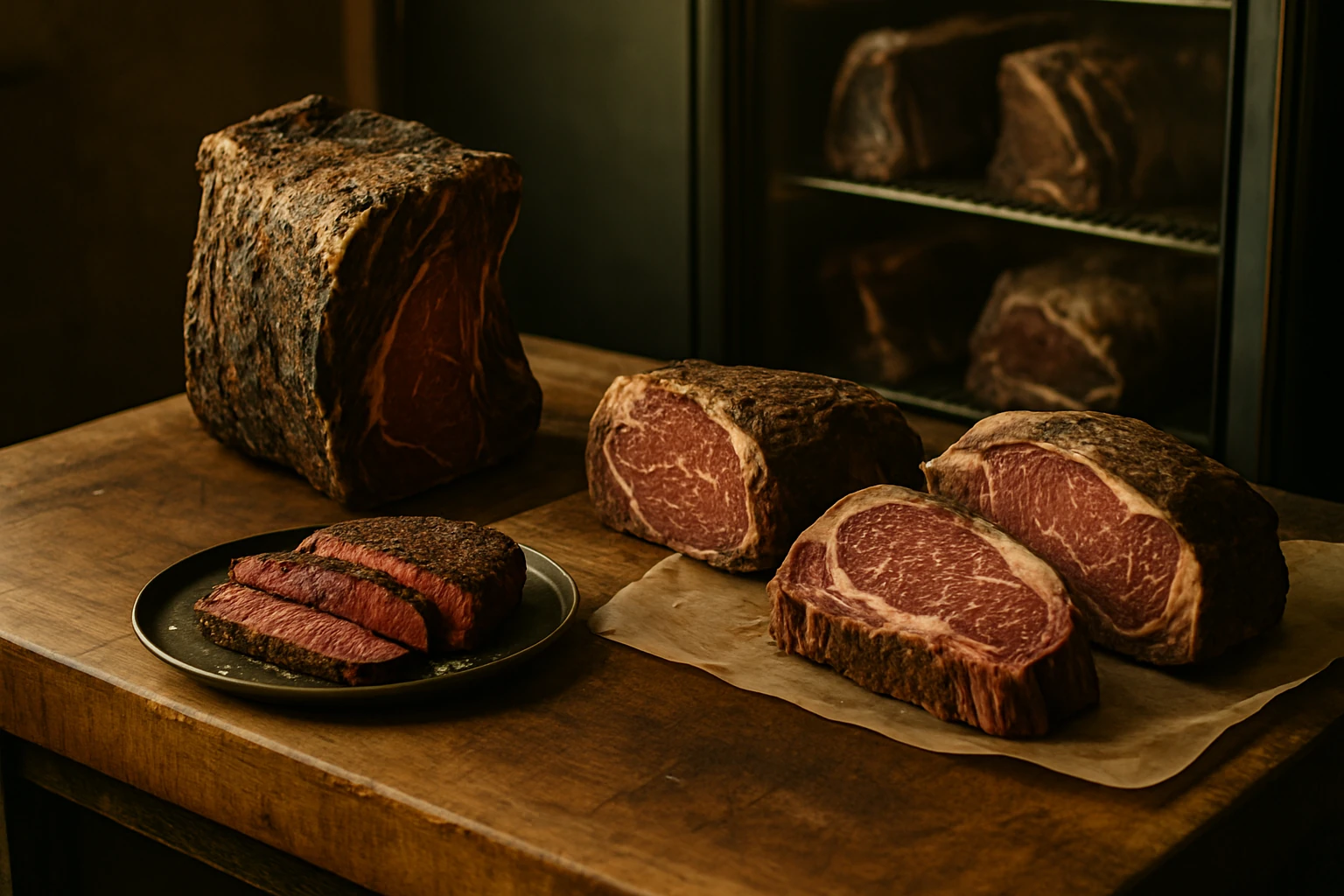
Dry aged beef is raw meat stored in precisely controlled temperature and humidity for weeks or months, allowing natural enzymes to break down muscle tissue while moisture evaporates. This process concentrates flavor, tenderizes the cut, and develops the funky, nutty, sometimes blue-cheese-like taste prized by steakhouses and serious carnivores. Unlike the vacuum-sealed wet aging most supermarket beef undergoes during distribution, dry aging exposes meat to air — a technique with roots in pre-refrigeration butchery that’s now a premium niche product commanding prices two to three times higher than standard cuts.
The science is straightforward: beef muscle contains enzymes called calpains and cathepsins that naturally break down proteins and connective tissue after slaughter. In a dry aging environment held at 34–38°F with 75–85% humidity and constant airflow, these enzymes work slowly over time while the surface of the meat forms a hard, dark crust. Moisture loss shrinks the cut by 15–30% depending on duration, intensifying beefy flavor as water evaporates. Simultaneously, fat oxidizes and Maillard-reaction precursors develop, creating the complex, aged character that distinguishes a 45-day ribeye from a fresh one.
The Aging Window: 14 to 120 Days
Most commercial dry aging runs 21 to 45 days. Shorter than 14 days produces minimal flavor change — the meat simply loses some water weight without meaningful enzymatic tenderization. The 28-to-35-day range is the industry sweet spot: enough time for noticeable funk and tenderness, short enough that yield loss remains economically tolerable for high-volume steakhouses. Premium programs push 45 to 60 days, where the flavor shifts from “rich and beefy” to “intensely savory with earthy, almost fermented notes.”
Beyond 60 days, diminishing returns set in. A few specialist butchers and steakhouses age certain cuts — typically bone-in ribeyes or short loins — for 90 to 120 days, marketing the extreme funkiness to niche customers willing to pay the corresponding premium. Yield loss accelerates with time: that 15% shrinkage at 30 days can reach 30% or more at 90 days once the dried crust is trimmed away. The economics only work for prime-grade beef with substantial fat marbling, sold at prices that offset the loss.
Beef graded Choice or Select rarely justifies extended aging. Lower marbling means less intramuscular fat to protect the muscle during moisture loss, and the resulting improvement in tenderness or flavor doesn’t overcome the yield penalty. Prime grade — roughly the top 5% of US beef production — has the marbling density and initial quality to benefit from the process.
Which Cuts Are Worth Aging
Dry aging works best on large, well-marbled subprimals with protective bone or fat cap. The classic choice is the bone-in ribeye (also called prime rib when sold as a roast): heavy marbling, thick fat cap, and enough mass that surface trimming doesn’t obliterate the yield. The bone conducts moisture away from the interior and adds structural integrity during the aging period.
The strip loin (New York strip) is the other workhorse of dry aging programs — slightly leaner than ribeye but still well-marbled in prime grade, with a fat cap that shields the muscle. Some high-end butchers age short loins bone-in, yielding both strip and tenderloin, though the tenderloin’s lack of fat makes it a marginal candidate on its own.
Porterhouse and T-bone cuts come from aged short loins. Individual steaks are almost never dry aged after portioning — the process requires substantial mass and protective exterior tissue. Attempting to age a lone 1.5-inch steak in a home refrigerator will simply dry it into jerky; the surface-to-volume ratio is wrong.
Lean cuts like sirloin, round, or tenderloin are poor aging candidates. Without sufficient intramuscular fat, they lose moisture without gaining enough flavor complexity to justify the yield loss and effort. The tenderization effect is real but modest, and cheaper mechanical or enzymatic tenderization achieves similar results.
The Flavor Profile: What to Expect
Fresh beef tastes clean, metallic, and straightforwardly beefy. Dry aged beef adds layers. At 30 days, expect concentrated beefiness with subtle nutty or buttery notes and a hint of funk in the finish. By 45 days, the funk moves forward — think aged cheese, earthy mushroom, or the faint tang of fermentation. Fat that was once neutral and creamy now tastes richer, almost cultured.
Beyond 60 days, polarization begins. Some eaters describe the flavor as blue cheese, truffle, or sophisticated umami. Others find it overpowering, bordering on spoiled. The line between “funky” and “off” is subjective and culturally informed — American palates generally prefer aging in the 28-to-40-day range, while some European and Japanese programs push further.
The crust that forms on the exterior during aging is always trimmed before cooking. It’s desiccated, hard, and sometimes shows surface mold (which is normal and harmless — proper aging rooms manage surface flora, and the crust is discarded). The flavor you taste comes from enzymatic and oxidative changes in the interior muscle and fat, not from the crust itself.
Wet Aging vs. Dry Aging: Economics and Outcomes
Most beef sold in the US undergoes wet aging — the practice of vacuum-sealing subprimals in plastic and holding them at refrigerated temperatures for 7 to 28 days during distribution. This allows some enzymatic tenderization without any moisture loss, making it vastly more economical. A wet-aged steak arrives at retail with nearly 100% of its original weight; a dry-aged steak has already lost 20% or more to evaporation and trimming.
Wet aging produces cleaner, milder flavor. There’s no funk, no crust, no oxidation — just incremental tenderness as enzymes work in the anaerobic environment of the bag. For most consumers, this is ideal: tender, beefy, and affordable. Wet aging also allows centralized fabrication and long-distance shipping with minimal quality loss.
Dry aging requires dedicated climate-controlled space, constant monitoring, and acceptance of significant yield loss. It’s a premium product by necessity, not marketing. The question isn’t which is objectively better — it’s whether the dry-aged flavor profile is worth roughly double the price. For a percentage of steak buyers, it is. For most, it isn’t.
Buying and Storing Dry Aged Beef at Home
Dry aged beef is sold by high-end butchers, specialty meat purveyors, and some upscale grocery chains with in-house aging programs. Expect to pay $30 to $60 per pound for prime ribeye or strip aged 30 to 45 days, compared to $18 to $30 for non-aged prime. Online vendors ship vacuum-sealed portions; the aging happens before sealing, so the product arrives shelf-stable but should be cooked within a few days of opening.
Attempting dry aging at home is possible but requires precise equipment. A dedicated refrigerator (not your household fridge, which opens constantly and holds aromatic foods), a small fan for airflow, and a reliable hygrometer to monitor humidity are minimum requirements. Consumer-grade “dry aging bags” are a compromise: they allow some moisture loss and enzymatic activity in a standard refrigerator but don’t replicate true dry aging conditions. Results are generally acceptable for 14-to-21-day attempts with prime ribeye, marginal beyond that.
If you purchase pre-aged beef, treat it like any high-quality steak: bring to room temperature before cooking, season simply with salt, and use high direct heat. The concentrated flavor and tenderization are already built in. Overcooking to well-done defeats the purpose — medium-rare to medium preserves the texture and rich fat that justify the premium.
Why Steakhouses Use It (And Why Most Don’t)
High-end steakhouses anchor their reputations on dry aged beef because it delivers a differentiated product that customers can taste and that’s difficult to replicate at home. A 40-day ribeye is a story, a signal of seriousness, and a reason to charge $80 for a 16-ounce steak. Restaurants with dedicated aging rooms — glass-fronted and visible to diners — turn the process into theater.
But most steakhouses don’t dry age. The majority purchase wet-aged prime from large distributors, relying on proper sourcing, grading, and cooking technique to deliver quality. Wet-aged prime, cooked correctly, satisfies the vast majority of customers at a price point that fits mid-tier steakhouse economics. Dry aging is a margin calculation: does the 50–100% price premium you can charge exceed the yield loss and operational cost? For most operators, it doesn’t.
For home cooks and beef enthusiasts, understanding dry aged beef means recognizing it as one tool in the quality continuum — not magic, not mandatory, but a legitimate and historic method that produces distinct results when conditions and economics align. The takeaway: if you haven’t tried it, seek out a reputable 30-to-40-day ribeye at a knowledgeable butcher or restaurant and decide whether the funky, concentrated intensity is worth the premium for your palate and budget.
Read the pillar
Consumer Beef Education