Boxed Beef Cutouts Slip $3 as Weekly Trading Volume Hits 560 Loads
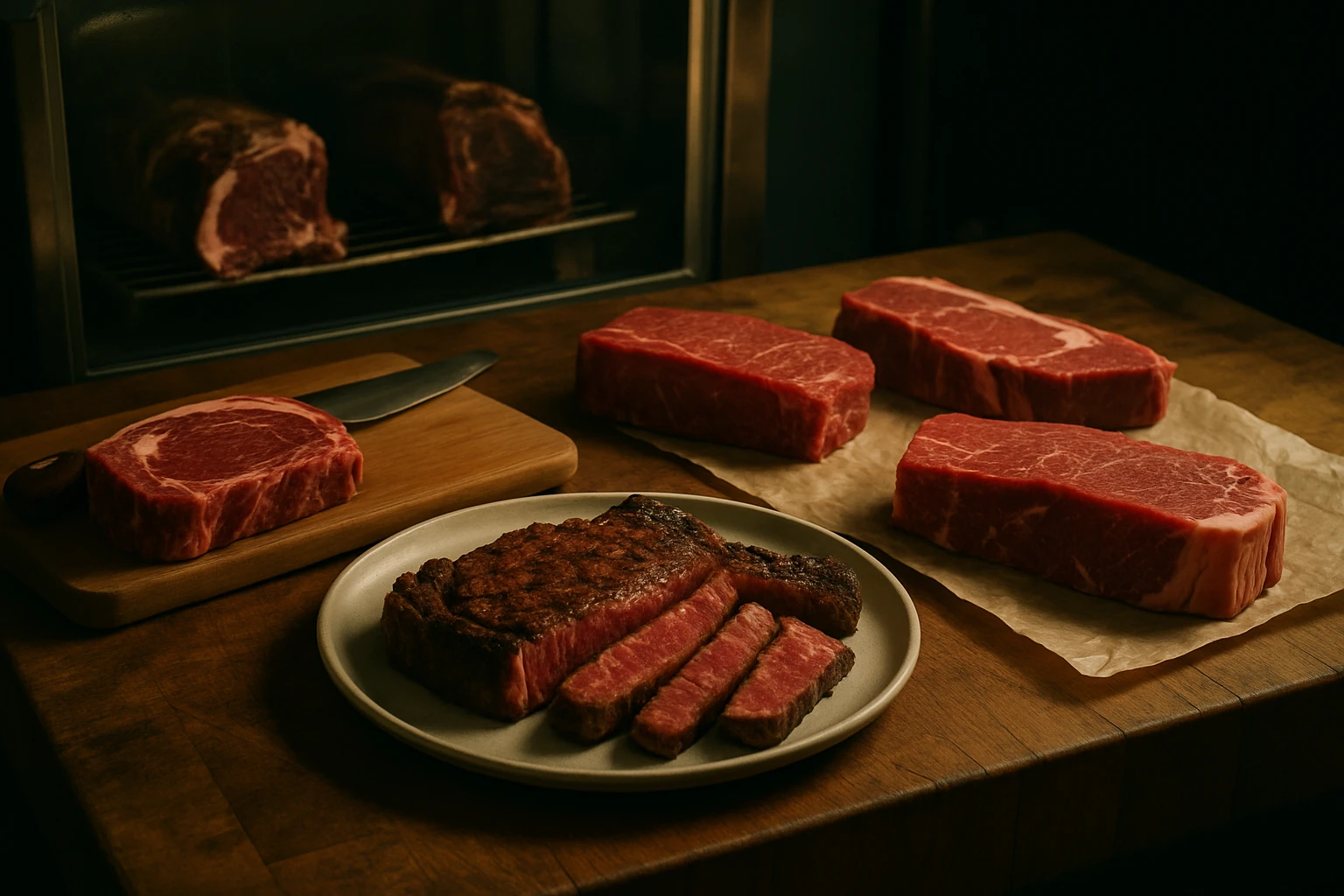
Boxed beef cutout values declined modestly in the week ending October 9, 2026, with Choice falling $3.18 to $376.20 per hundredweight and Select down $3.10 to $355.03, according to USDA data released October 9. The Choice-Select spread held at $21.17, while negotiated sales totaled 560 loads across cuts, trimmings, and grinds—a solid volume reflecting sustained packer-buyer activity.
Choice cuts dominated weekly trade at 384.37 loads (15.37 million pounds), compared to 71.76 loads (2.87 million pounds) of Select. Ground beef accounted for 70.55 loads, with 81% lean averaging $342.48 per cwt and 85% lean at $414.26. Trimmings moved 33.35 loads, with fresh 50% lean material ranging from $71.50 to $118.60 per cwt and averaging $93.41.
Primal values showed notable variance. Choice ribeye cuts remained the premium category, with bone-in ribeyes (IMPS 109E) averaging $1,365.74 per cwt and boneless heavy ribeyes (112A) at $1,569.32. Choice strip loins (IMPS 180) averaged $965.84, while tenderloins (189A) commanded $1,632.07. On the Select side, ribeyes tracked significantly lower—bone-in at $1,183.19 and boneless heavy at $1,177.56. The Choice rib primal averaged $670.62 per cwt for the week versus $563.49 for Select, a $107.13 difference that underscores persistent grade-driven demand splits.
Round and chuck primals showed tighter Choice-Select differentials. Choice chuck averaged $333.44 per cwt compared to Select’s $329.72, a $3.72 gap. Round primals actually inverted slightly, with Select at $296.00 versus Choice at $294.68. Brisket values also converged, with Select at $296.29 and Choice at $293.75.
Daily cutout readings fluctuated within a narrow $5.58 range for Choice during the week, peaking at $378.93 on October 6 and closing at $373.35 on October 9. Select values moved in a similar $6.84 band. The consistent load counts—ranging from 67 to 131 per session—suggest steady procurement patterns rather than inventory scrambles. Whether this stability persists will depend on retail demand signals and fed cattle supplies heading into late autumn. [Source: USDA LM_XB459 — October 9, 2026]
Read the pillar
US Cattle Market Data